Biryani Is India's Most Ordered Food for 7 Years: Here's Why
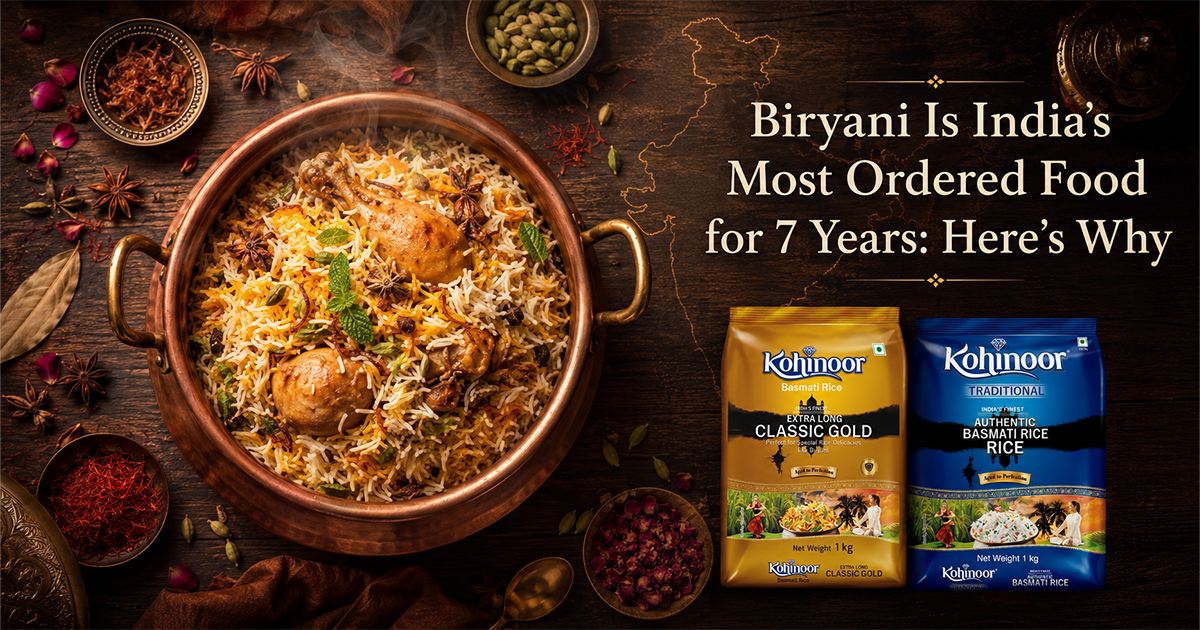
India ordered 93 million biryani plates on Swiggy in 2025, making it the 10th consecutive year that biryani was the country's most ordered dish. Not pasta. Not pizza. Not even dal makhani. Biryani. Every single year. So what is it about this one dish that makes 1.4 billion people reach for it again and again on birthdays, at midnight, on a random Wednesday? The answer is bigger than flavour.
| Stat | Figure |
|---|---|
| Plates ordered on Swiggy (2025) | 93 million |
| Consecutive years as India's #1 dish | 10 years |
| Average plates ordered per day | 2.9 million |
| Top ordering city | Hyderabad |
| Most ordered variant | Chicken biryani |
| Fastest growing variant | Vegetarian biryani |
| Peak ordering time | 11 PM – 2 AM |
| Fastest growing markets | Tier 2 cities (Bhopal, Indore, Jaipur) |
Ninety-three million plates in one year is roughly 2.9 million plates ordered every single day. That is not a trend; it is a cultural institution. The numbers have grown nearly every year, suggesting not just loyalty but an expanding first-time customer base constantly entering the fold.
Zomato's annual data mirrors Swiggy's findings across every city tier, metro, Tier 2, and Tier 3. When two competing platforms with different user demographics independently reach the same conclusion, the data stops being a statistic and becomes a fact about Indian identity.
Hyderabad leads, consistently and unsurprisingly. Bengaluru, Chennai, Mumbai, and Lucknow follow closely. But smaller cities, Bhopal, Indore, Jaipur, Coimbatore, are growing fastest, suggesting the biryani wave is deepening, not just widening.
Chicken biryani dominates by a considerable margin. Vegetarian biryani, particularly paneer variants, is the fastest-growing category, reflecting both India's large vegetarian population finding better options and the dish evolving beyond its non-vegetarian roots.
Biryani consistently ranks in the top three items ordered between 11 PM and 2 AM. Late-night orders are primal hunger that needs to be satisfied quickly and completely. The fact that biryani wins even at midnight says everything about how deeply it is embedded in the Indian psyche.
Rice, protein, fat, spice, caramelised onion, fragrant herbs, and biryani are a one-pot meal that needs nothing else. In a country where time is at a premium, this completeness is deeply appealing.
Ask any Indian what they ate at their last wedding, birthday, or Eid gathering, and biryani will almost always feature. It has become the default language of celebration across religions and regions, transcending cuisine to become a ceremony.
There is a specific comfort biryani delivers that few other dishes can match. The smell of it arriving at the door—that warm, spiced, slightly smoky waft—tells the brain before the first bite that everything is going to be fine. Biryani has been present at enough significant life moments that it now carries emotional memory in every grain.
No other Indian dish belongs equally to Hyderabad and Kolkata, to Kerala and Kashmir. Every Indian has their biryani, the version they grew up with, yet they will happily eat another region's version. That regional plurality drives extraordinary national reach.
The dum technique seals the pot, trapping steam and moisture that continuously re-bastes every grain and every piece of protein. The result is a concentrated, penetrating flavour impossible to achieve with a covered pan on high heat. Layering builds internal contrast, deeply spiced meat beside almost-plain saffron rice, so no two spoonfuls taste identical.
The deeply golden birista (fried onions) contribute hundreds of new flavour compounds through the Maillard reaction. And none of it works without the right grain. Kohinoor Basmati's aged, extra long grain absorbs the dum steam without breaking, stays separate, and adds its own quiet aroma to the layered whole. The rice is not the supporting cast; it is the stage.
Challengers exist in burgers, shawarma, and Korean fried chicken, but none carry the cultural weight of biryani. The dish also keeps evolving: Afghani biryani, millet biryani, and regional variants are going national on delivery apps. Biryani is a living dish; living dishes do not become obsolete. Internationally, it is increasingly India's most recognisable culinary export, the first dish travel writers tell you to try. As long as families gather around a steaming pot on Sunday afternoons, biryani holds its place. And every great biryani starts with the right grain.
Ten consecutive years as of 2025, according to Swiggy's annual food trend data.
Hyderabad leads in both volume and per-capita consumption, followed by Bengaluru, Chennai, Mumbai, and Lucknow.
It is a complete meal, a celebration food, emotionally comforting, cross-regionally beloved, delivery-resilient, and endlessly variable. It satisfies practical, cultural, and emotional needs simultaneously.
Chicken biryani, by a significant margin. Vegetarian biryani is the fastest-growing category.
Ten consecutive years as of 2025, according to Swiggy's annual food trend data.
Hyderabad leads in both volume and per-capita consumption, followed by Bengaluru, Chennai, Mumbai, and Lucknow.
It is a complete meal, a celebration food, emotionally comforting, cross-regionally beloved, delivery-resilient, and endlessly variable. It satisfies practical, cultural, and emotional needs simultaneously.
Chicken biryani, by a significant margin. Vegetarian biryani is the fastest-growing category.
The perfect way to stay up-to-date with all the latest news and offers. By signing up, you'll receive regular updates about new product launches, exclusive promotions, and delicious recipe ideas to try at home. Our newsletter is a great way to get inspired in the kitchen. So why not sign up today and join the Kohinoor community?
We look forward to sharing our passion for rice and biryani with you!
